
Why Space Is Not Empty
This essay explores why space is not an empty void, but a dynamic physical environment filled with particles, plasma, and magnetic fields that directly shape satellite orbits, space travel, and modern technology. Drawing from space physics, it explains how low-density matter, the solar wind, and Earth’s magnetic field interact to create structure in near-Earth space, drive orbital decay, and produce space weather. The post connects fundamental plasma physics to real-world effects on GPS, communication systems, radiation exposure, and power grids, reframing space as an active medium rather than a vacuum.
Geoff Jenkins
1/10/20265 min read
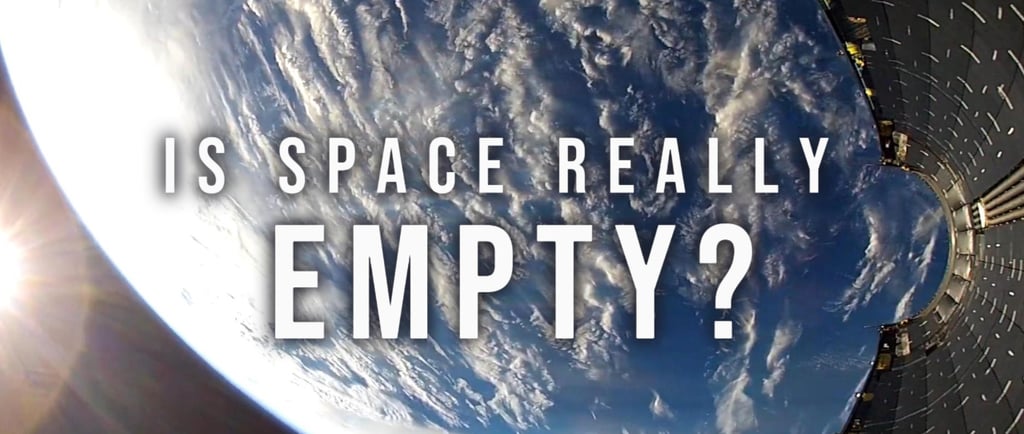
We often talk about space as though it is empty, as if it were a void or a kind of physical nothingness. In physics, however, “empty” does not mean nothing at all. It means thin. And thin, in physical terms, is still something. Space is not an absence; it is an environment, and nearly everything we do beyond Earth depends on understanding that fact.
When people say that space is empty, they are usually referring to the absence of familiar atmospheric properties. There is no air to breathe, no oxygen to sustain life, no pressure, and no medium for sound to travel. These statements are correct in an everyday sense, but everyday intuition is not how physics operates. Physics is governed by density, not by human experience, and while the density of matter in space is extremely low, it is not zero.
In Earth’s lower atmosphere, there are on the order of ten billion billion particles packed into every cubic centimeter. In interplanetary space, that number can drop to just a handful of particles in the same volume. The contrast is extreme, but it is still a contrast between “a lot” and “very little,” not between “something” and “nothing.” Even in the vast distances between stars, atoms continue to drift. Hydrogen and helium linger as remnants of earlier generations of stars that formed, lived, and died long before our own solar system existed. What we call “empty space” is more accurately described as space that contains almost nothing, and that distinction turns out to matter a great deal.
The physical content of space begins with particles: protons, electrons, and ions. Many of them originate from the Sun, while others arrive from more distant cosmic sources, but all of them move at extraordinary speeds, often hundreds of kilometers per second. Although they are sparse, these particles carry momentum and energy, and they interact continuously with anything moving through them.
Every satellite in orbit is immersed in this particle environment. Every astronaut is exposed to it. Every mission that leaves Earth must account for it. If space were truly empty, satellites would continue moving indefinitely without change. In reality, they slow down, their orbits decay, and eventually they fall back toward Earth. That gradual loss of orbital energy can only occur because there is something present to interact with them.
The dominant contributor to this interaction near Earth is the solar wind, a continuous stream of charged particles flowing outward from the Sun at speeds typically ranging from four hundred to eight hundred kilometers per second. Rather than being struck by occasional isolated impacts, spacecraft move through a flowing medium composed of particles and magnetic fields. Even when that medium is extremely thin, a continuous flow still exerts a continuous force.
Because the density is low but the flow is persistent and fast, momentum is transferred gradually over time. There is no single moment when a satellite is suddenly “hit” and slowed down. Instead, thousands of microscopic interactions occur every second, accumulating into measurable changes over months and years. This is why satellites do not remain in low Earth orbit forever and why that region of space is fundamentally unstable. The slow decay of orbits is a direct consequence of the fact that space is not empty.
Particles alone, however, are only part of the story. Space is also structured by fields, particularly magnetic and electric fields. These fields are invisible and cannot be photographed directly, but they play a central role in shaping how matter and energy move. Earth has a magnetic field, the Sun has a magnetic field, and the space between them is permeated by both.
Magnetic and electric fields guide the motion of charged particles, bend their paths, store energy, and impose order on what would otherwise be chaotic motion. If particles are the substance of space, then fields provide its underlying architecture. Charged particles do not move randomly; they respond to forces. When a particle enters a magnetic field, it begins to spiral and follow the shape of the field line. If that field line curves back toward Earth, the particle can be guided into the planet’s magnetosphere.
Over time, this process leads to the accumulation of particles in specific regions around Earth. During strong solar storms, those regions can release stored energy and particles, only to slowly rebuild again afterward. This is why Earth possesses radiation belts and why energy tends to concentrate in certain zones rather than dispersing evenly. What initially appears to be empty space turns out to have a complex and organized structure.
Fields do more than guide particles; they actively reorganize them. They create regions where energy can persist for long periods, turning brief encounters into long-lived reservoirs of magnetic and particle energy. Without these fields, particles would simply pass by Earth without being captured, and no such structure would exist.
When particles and fields interact strongly, the result is plasma. Plasma is an ionized gas in which particles carry electric charge, and it behaves very differently from a neutral gas. It conducts electricity, supports waves, and couples directly to magnetic fields. Stars are made of plasma. The solar wind is plasma. Much of the space surrounding Earth is plasma, and more than ninety-nine percent of the visible universe exists in this state.
A defining property of plasma is that it behaves collectively rather than as a collection of independent particles. In a neutral gas, individual molecules can move without strongly affecting their surroundings. In plasma, changes in one region can influence the entire system. Disturbances propagate through particle populations and fields, rather than remaining localized. This collective behavior explains why the near-Earth space environment can change rapidly and continuously.
These changes are what space physicists refer to as space weather. They include compressions, waves, shocks, and large-scale reorganizations of plasma and magnetic fields driven by activity on the Sun. These terms are not metaphors; they describe real physical processes occurring in the space around our planet.
The consequences are not abstract. Variations in the space environment affect satellite drag, GPS accuracy, radio communication, radiation exposure, and even electrical power systems on the ground. GPS signals must pass through plasma, and when plasma density changes, signal paths and timing can shift, producing navigation errors. Astronauts must account not only for microgravity but also for radiation doses during energetic particle events. Airlines reroute polar flights during periods of strong space weather because communication reliability and radiation exposure both increase.
When the Sun becomes more active, the space around Earth changes. When that space changes, the technology we rely on responds accordingly. This entire chain of effects exists for a single underlying reason: space is not empty.
Earth is embedded within this environment, surrounded by magnetic fields, immersed in charged particles, and constantly moving through solar plasma. The boundary between Earth and space is not a sharp wall but a gradual transition. We do not step abruptly into space; we fade into it.
Most of the plasma that shapes our environment originates from the Sun. Not only its light and heat reach us, but also its particles and magnetic fields, flowing outward continuously as the solar wind. This outflow never stops. It is occurring at this moment.
The Sun is not merely shining on space; it is actively creating the environment through which Earth moves. Life on this planet did not evolve alongside a distant star. It evolved within the extended atmosphere of one.