Holding Steady in the Crosswinds
Lessons from the Prozac taper: finding clarity, staying grounded, and rising with the people who matter most.
Geoff Jenkins
11/19/2025

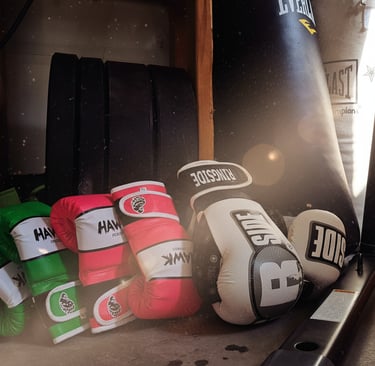
I’ve spent much of my adult life living at an intersection of extremes: the discipline of space physics, the emotional demand of creating heavy music, the chaos and joy of raising children, and the brutal clarity of boxing. Each of these worlds demands something different from me, and each has shaped the way I handle struggle. I don’t quit because something is hard. I learned early that life never gets easier, so you have to get stronger. But even with that philosophy carved into me, there are parts of my life that challenge me in ways that require more than pure grit.
Tapering off antidepressants is one of them. I know the chemistry, the half-lives, the timelines, the delayed reactions. I understand the science, but my body doesn’t care about the science. Every dosage reduction hits me with the same predictable nightmare of side effects: irritability that launches out of my mouth before I can snuff it out, burning pressure in my chest and skull, a reset on my breathing during training, and eventually a sputtering few-week depressive state. I’ve been through withdrawals that feel like my brain is being soldered. Years ago, when I came off Zoloft, I spent more than a month waking up to daily thoughts of self-harm. The thing that kept me here wasn’t hope or joy. It was a decision made long ago, a stubbornness really. I’m not going anywhere until something or someone physically takes me out. That refusal to bow out is part of who I am, and it has kept me alive long enough to climb out of that depressive hole time and time again.
Now, as I work my way off Prozac, the taper is still hard. I missed a day at 20 mg, so I’m taking the opportunity to drop to 10 mg. This time, I’m expecting the wave. Week one usually feels normal, then week two hits with all the side effects. I get mouthy, I lose patience, and I bowl chaos into my own house even when I don’t mean to. I feel shame in that, and frustration, because I care deeply about the people around me and I don’t want my actions to impact them negatively. But the truth is, we have all started to notice this pattern together. My family knows when it is the taper lighting the fuse. I’m not hiding anything, and that transparency makes this period navigable. It keeps us grounded as a unit instead of confused and hurt in separate corners.
The tools I use now are the tools that have shaped much of my life. Boxing has taught me how to move energy efficiently and gives me a healthy outlet for the raged version of myself that sometimes lives inside. Walking clears my mind, and it is often where inspiration for music, videos, and research strikes. Writing, whether it becomes an essay, a lyric, or a private reflection, is how I turn internal chaos into something structured instead of letting it stay amorphous and dark. And when I need accountability or someone to lean on, I reach out to a friend or talk openly with my partner. When I do these things regularly, they stop being coping mechanisms and start becoming disciplines. They help me stay myself when my brain’s chemistry tries to distort my perception.
What I am learning in this stage of my life is that strength isn’t just about pushing harder. Real strength is knowing how to stay standing when the ground shifts underneath you. I’m not afraid of discomfort, or pain, or staring into the unknown. I’m afraid of losing who I am to something I didn’t choose. That fear keeps me watchful. It keeps me connected to the people I love.
I’m a space physicist in training, a heavy music lifer, a father who is becoming more excited daily, and a boxer who knows exactly what it means to take hits and keep moving forward. All of those identities orbit the same core: I don’t quit. And my girls are going to grow up seeing that firsthand.